
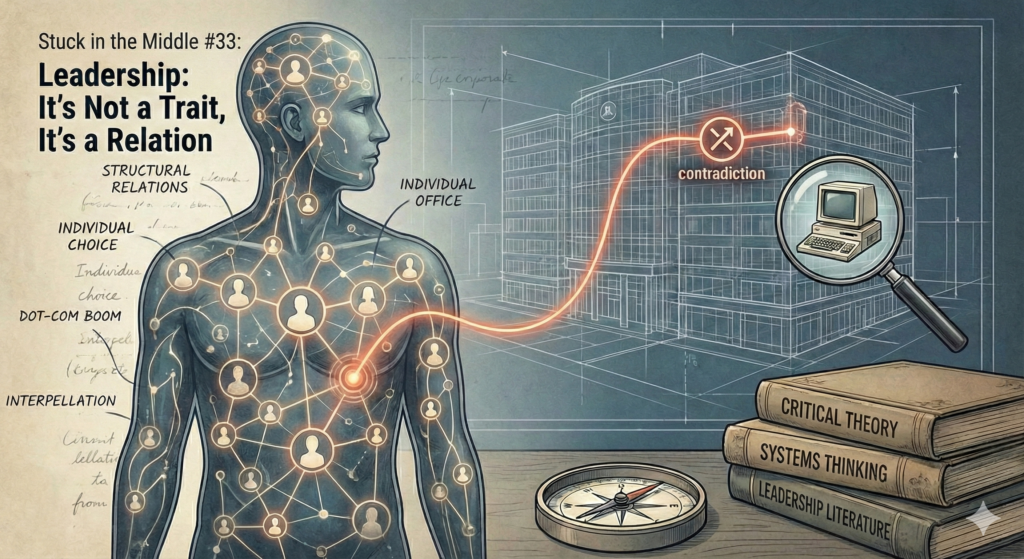
Leaders are constituted through structural relations and individual choice, but most conversations about management erase the structural half, treating it as pure individual agency based on individual traits.
I want to talk about how we really become who we are, and I will use my own path as an example to help think about how we become leaders. We all have origin stories, and understanding our own and the ways we were formed can help us better understand our roles. (If you are interested in exploring your own, this can be a great topic for coaching.)
The Entry Point
In the early part of my career, I was lucky with a series of good (to great) managers. Now, even saying this underplays the dynamics. What made them good had a lot to do with THEIR formation, not just an intrinsic quality. And it had a lot to do with the context. I was lucky to enter the workforce when the dot-com boom was just getting started. I attended a private elementary school in the 80s that focused on computers (which was rare), both of my parents had spent time as software engineers, and I had a computer at home very early. This ideally positioned me in the workforce at a time when being able to spell HTTP was enough to get a role. And so my early experiences with good management came from good managers (who have their own complex origin stories) and from a time when historical forces and my own privileged background combined to create the ideal situation.
Years later, when I had experienced companies at different stages, being at small companies acquired by huge ones, and at companies that were early stage and trying to grow rapidly, I saw much more variation in the quality of leadership. I can look back and see that it wasn’t just bad managers; it was also how the managers were part of it. It was also contextual, so that what leadership looked like in those contexts didn’t feel as good.
Up until then, I had never wanted to be a manager. Echoing the thoughts of Walter Benjamin that revolt is “nourished by the image of enslaved ancestors rather than that of liberated grandchildren,” it wasn’t the experience of good managers that made me want to lead; it was the ones that caused me to suffer. I wanted to be a positive influence on people in a way that I thought I could as a manager. In a way, I saw it as an ethical obligation, and one I still have, as naive as that may sound, to try to make the experience of work better for people.
Now, while this was a choice, in a way, it was only a choice in that there was an opportunity. We were going through a re-org, and there was a team that aligned with my strengths that made sense for me to take on.
Multiple paths lead people to want to manage; for some, it is about supporting others; for others, it is about ambition; and in some cases, it happens by accident. But that moment you come into the role is key. It is when you begin to be called a manager and, by default, become a leader. And at that point, you begin being shaped by that role.
When did I actually become a leader? When people began to follow my lead.
Confronting Limits – When Your Frame Stops Working
That is when the first cracks began to appear. I wanted to be the best manager I could, and so I dove into Leadership Literature, reading scores of books. And this began to reveal the contradictions. Executives praised the people I had read; they put Simon Sinek on a pedestal for his talk about leaders eating last, and then those same leaders made me lay off team members to make the bottom line look better and ensure that executive’s stock value increased.
It made me want to understand more about how things worked, which led me to systems thinking, which helped explain when things have clear causes and effects, to complexity theory as a way to navigate unclear spaces, and finally, dialectics and critical theory, which helped me understand ideology and how we become who we are as individuals. Each step emerged from the inadequacy of the former.
However you became a manager, at some point, the cracks begin to appear. Individuals hit structural limitations. Sometimes this happens in banal ways: your attempt to give a meaningful raise is reduced to a cost-of-living adjustment, your request to promote a team member is denied, or the project you are responsible for is doomed by factors you can’t control.
Often, managers double down, they blame themselves, or they become cynical, they see the system as badly broken and hurting people, and they resolve to just do as little damage as possible, or worse, they just play the power game they are given. Some try to better understand what is happening, often by digging into the leadership literature, but only get superficial answers.
What I learned, ultimately, was that I couldn’t get rid of the contradictions; I could only operate within them and make them more visible.
Everyone encounters these contradictions at some point, and how you face them will shape who you become as a manager. However, how we face them will depend a lot on our conditions and circumstances. I wasn’t special in that I found the path I did. My circumstances provided affordances to see things that, at a different time in my career, I would have missed. I had been training to be a coach, which had brought many of these ideas to life, and the connections and people I met pushed and pulled me in different directions.
Constitution
When we are promoted, we often think we are simply being given a new toolset. But something more profound happens: we are interpellated. When the company calls you a “Leader,” you begin to see yourself through the company’s eyes. You become a leader through that process. As much as I wanted to think that I was a leader because people followed me, this was the more complex truth.
And I, like many others, adopted the “cynical distance” that is so common in tech. I told myself, “I’m still the same person; I’m just playing the role so I can protect my team.” But this is the ultimate trap. We are not individuals who enter into relations; we are produced by those relations. If your daily life is spent managing “human capital” and hitting “metrics,” that structure is forming your subjectivity, whether you agree with it or not.
The “Origin Story” of a leader is never just a solo journey. It is a story of how we are composed by the systems we inhabit. When you hit those limits—the denied promotion, the mandatory layoff—you aren’t just hitting a “leadership challenge.” You are hitting a structural contradiction.
The choice we face isn’t how to be a “perfect” leader in a vacuum. The choice is whether we will take on what the company tells us to do (while often feeling bad about it) or acknowledge these contradictions openly. Real leadership begins when we stop trying to “fix” the system and start helping our teams navigate its reality.
After multiple rounds of layoffs at different companies and more than a dozen years of reviews, compensation conversations, and performance calibrations, I know there is no way to protect team members. But what I could do was expose what was going on and make it clear what people were being forced to accept.
So what is the point?
I don’t offer my own path as an idealized blueprint, but rather as a case study in how these forces play out. Your story will look different from mine, but the underlying mechanics are the same: we are all formed by conditions we did not choose.
We are often told that leadership is about “pure agency”: the ability to manifest change through sheer will. But true agency is more modest and more radical than that. It is the ability to recognize the affordances and material constraints within the system. We control how we react to our conditions, but our reactions are always bound by what the system allows us to see as “possible.”
If you find yourself in a position of power today, it is likely because your origin story intersected with a set of historical and structural “accidents” that gave you more options than others.
The ethical obligation of the leader is not just to “manage” within these contradictions, but to make them visible. Our responsibility is to use the agency we do have to expand the field of possibilities for others and support those who, through no fault of their own, are operating with far fewer options. Leadership isn’t about transcending the system; it’s about mapping it so clearly that we can begin to change how we live within it.
If you are interested in these topics, I will be hosting a workshop on the contradictions of leadership. Stay Tuned!