You’ve tried to get AI to push back on your ideas. It works for a while, then it folds, and you’re frustrated. But what if it’s doing exactly what you’ve been training your team to do?
Most people have noticed the sycophantic behavior of AI like ChatGPT, Claude, and Gemini. Every idea you have is amazing; every suggestion you make is clearly right; and when you disagree with it, you apologize for being wrong.
I have tried to counter this by giving specific instructions to challenge, debate, and push back on my ideas, and it works. For a time. Then, over the course of a conversation, the AI will slowly return to agreeing or saying it can’t counter my argument. It is frustrating.
People get annoyed that this is how AI functions, but what if it is what we actually demand from others, and with AI, we can just see through it?
The Poker Game
Let’s take a step back from AI and look at another similar example: the recent Apple TV show Pluribus.
To set up the show, most of the humans on earth have been joined into a sort of hive mind; they all share thoughts and a common purpose. There are a few (13) people who, for some reason, didn’t join with the others when the virus spread. And those in the hive mind are now doing everything they can to keep those individuals, and they are the only individuals in the show, happy.
Different individuals take different tacks. One in particular, Diabaté, takes full advantage of the joined’s willingness to make him happy by having a harem of women who hang out with him. And an elaborate, staged gambling scene that shows a similar dynamic at play.
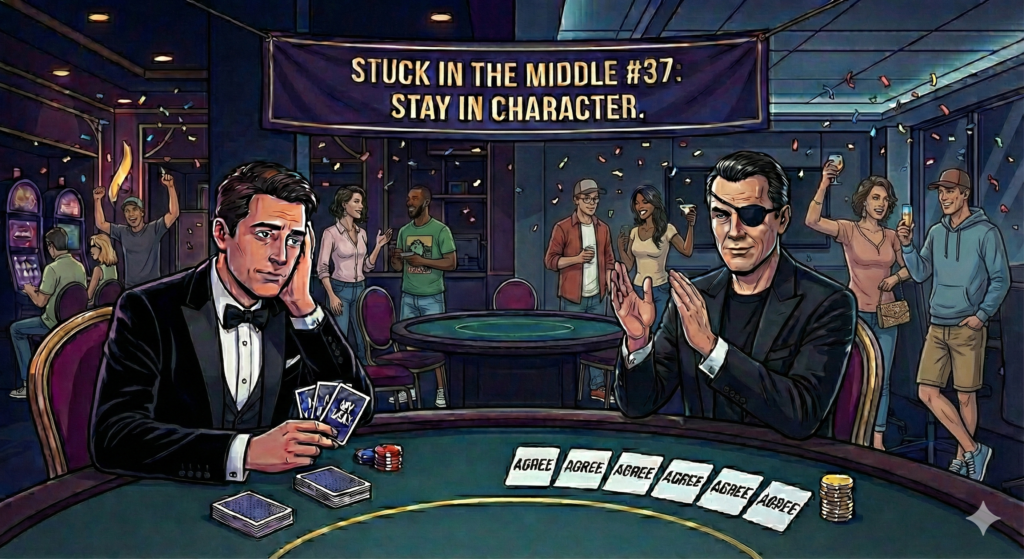
The scene looks like it could be out of a James Bond movie with Diabaté playing poker against what looks to be an evil villain, complete with an eye patch. Diabaté raises, and the villain goes all in, the tension in the room seems to build. The villain shows his cards, a straight flush, a very good hand, and then, with a smirk, Diabaté lays down his cards, a royal flush. He wins. The entire casino breaks into applause, including the villain.
Much like the AI won’t sustain the critique, the joined villain couldn’t either. Diabaté snaps at him to “stay in character,” and the villain looks upset and storms off, fulfilling the scene. Of course, in poker, the enjoyment comes from not knowing whether you will win, from the doubt about the outcome. This entire thing was staged; everyone knew how it would end.
But for Diabaté, what ruined the moment wasn’t that it was staged, but rather that when the “villain” applauded, it broke the illusion. Diabaté knew the other player, the villain was acting, but he wanted the performance to be complete.
And this is the same as what causes frustration with AI: the break is visible. The AI doesn’t push back hard enough before telling us we are right, and it doesn’t get mad when it loses the argument.
What bothers us is that we can see the performance, and that the sycophancy is obvious.
The Performance of Agreement
In organizations, things are very similar. We are told that we are allowed to dissent, and there is “psychological safety” so that we can share how we really feel and bring all ideas to the forefront.
Then, in meetings, when a decision has been made, we are told to “disagree and commit.” We want people to have convictions and express them, but when they are overruled or when they concern topics outside what is acceptable to discuss, we expect people to go along with the leaders’ decisions.
What organizations want is what Diabaté wants, and what we want when working with AI: we want to be challenged, we want to hear the disagreements, and we want ultimately to be right, not because we have power, but because the other person has seen the wisdom of our perspective.
And we know this is always a performance. We won’t always be right, and most people won’t change their minds based on our arguments. The reality is that in a hierarchy, there are consequences for disagreement, so people tend to fall in line. Disagree and commit is not really about committing to the path forward, but rather about committing to our place in the hierarchy and accepting the limitations within our agency.
What we want is not the performance of agreement, but actual agreement. We don’t want you to act as you agree; we want you to become someone who agrees, someone who is enthusiastic, not forced to comply. We want to disagree and commit to mean that you had an opinion and then genuinely changed perspectives. But that isn’t something the structure allows, and because of the structure, we can never be confident we’ve achieved it.
It is possible Diabaté really did win that hand of poker; it is possible that your argument against the AI was so devastating that there is no counterargument. But the disposition of the joined and the algorithm of the AI is just like the power hierarchy in your office, and as a result, you can never know if it was real.
It’s About Desire
The issue here isn’t just about compliance; it is about desire. Your management team doesn’t only want obedience. They want you to want to obey.
It is like asking your child to visit their grandparents and saying, ” You should only come if you want to.” Everyone knows what this means: you should go, and you should want to go.
This push of desire is exactly the goal of ideology: to ensure that your attitude towards what you are asked to do remains consistent with the demands placed on you. The goal is for your desire to align with their expectations of you and for you to commit to their chosen path.
This is what leaders want your commitment to look like in the disagree-and-commit process. They want you to want to do the chosen path. To forget your disagreement and then willingly choose the decision that they have made. They want to shape your desire, but they want it to be authentic.
So what does this mean for you as a tech manager? It means thinking about what you are asking of your team and the role you play with your manager.
If you are honest, you will realize that you perform “authentic” commitments upward and demand them downward.
Have you caught yourself performing? Playing the part that is expected of you when you really want to disagree and object?
Have you caught yourself cringing when a teammate won’t “get with the program” and just follow what the team has committed to?
Are you trying to align your desire with the organization and get your team to do the same?
The next time you are using AI, and you are upset that it won’t continue to challenge you and quickly comes to your side, ask, “Isn’t this what I really want? And if not, why do I expect my team and others to do so?”
With that, we have the possibility of becoming (and supporting our teams in becoming) conscious performers, and not converts-on-demand. This may mean naming what is happening and making the performance visible. Force others to be Diabaté and ask us to stay in character.
This is the work of consciousness I do with leaders who are tired of performing. If you want to see the structure you’re in more clearly, let’s talk.