
Most corporate leadership isn’t leadership. It’s positional authority wearing a leadership costume.
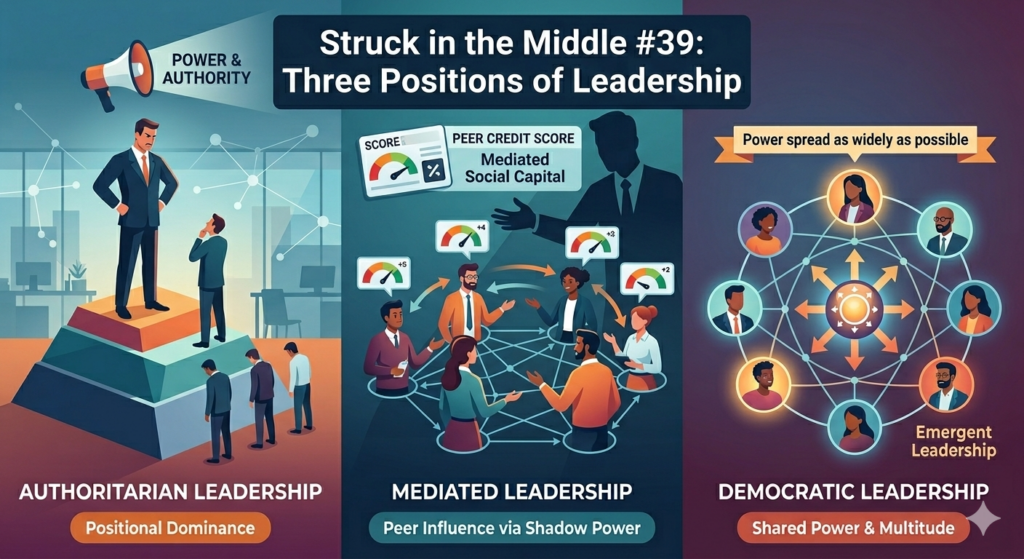
There’s a notion of tech leadership as a grand pursuit where people knowingly follow you. In reality, most leadership in corporations is positional. You are set up in hierarchies where your “leader” is merely the person you’ve been assigned to and need to follow. I’m going to postulate that there are really three leadership positions, and that recognizing which one you are in is valuable when you think about how you lead. I call these positions Authoritarian, Mediated, and Democratic Leadership. And what makes them different is how power is mediated in these different leadership positions.
Authoritarian Leadership
The first leadership position is the one we most commonly talk about in the corporate context. It is a hierarchical position in which you sit above others and hold formal authority and “leadership” over them. This is leadership with no authentic followership, as those who follow are not given a choice.
In most organizations, you don’t choose who you work for. The person you report to, your boss, is often referred to as the team leader, even though that position was granted by another authority, someone else who was a leader because the authority was granted to them. Now, why do people choose to follow someone? In these cases, it’s really hard to separate any genuine desire to follow a leader from the structural position. At its core, one of the main reasons we work is to earn money to survive. And as the authoritarian leader controls the employee’s access to fulfill that need through their job, the relationship is always one of domination.1
Let’s look at this through an analogy. Imagine that you’re walking down the street and someone approaches you with a gun. 2 They ask you for your money. Now, you would certainly prefer that they don’t shoot you and think of that person as a kinder person than the one who would. However, the decisions you make are going to be largely about the authority in the situation you’re in.
Now, some people might argue that they have a great relationship with your boss. But, even if they do, that doesn’t change the structural fact that there is a power hierarchy and that your manager can, on their own, make decisions that will have a huge impact on your life and career. The ability to exit a situation or to be happier in one doesn’t neutralize that structure. As Elizabeth Anderson explains,
This is like saying that Mussolini was not a dictator, because Italians could emigrate. While emigration rights may give governors an interest in voluntarily restraining their power, such rights hardly dissolve it. 3
Now, that said, it’s also important here to realize that people can follow willingly or unwillingly. When you have a good relationship with your boss, it feels positive. And through that, people can consent to the decisions that they are forced to make (what Lordon calls joyful determinism), or they can choose not to consent and to go along much more begrudgingly (what Lordon calls sad determinism). This has a real impact on people’s experience of the work. What doesn’t change is that, when you are working in a corporation, it is heteronomous. You are doing the work that others are telling you to do. You may enjoy it, but that doesn’t change the structure or the nature of the relationship.
Coercion and consent are forms of the lived experience (respectively sad and joyful) of determination. To be coerced is to have been determined to do something but in a state of sadness. And to consent… is to live one’s obedience, but with its intrinsic burden relieved by a joyful affect.4
What is often missed is that this joyful determination can actually be more effective in getting people to do what they need to do, and thus what may feel like autonomy is just heteronomy in disguise.
Mediated Leadership
The second position involves mediated authority. What do I mean by that? For example, if you are working with your peers in an organization and getting them to go along with your ideas and follow what you are doing, then you are a leader among those peers. However, this doesn’t remove a power dynamic entirely. They may be going along with you because you’ve been deemed the boss’s favorite, and there is an element of coercion. This is still, in general, a heteronomous relationship.
This is like your credit score without the ability to check it directly. You know what affects it, but exactly how it is calculated is always a bit opaque. Nobody’s threatening you, but a number is being updated in real time based on how every interaction with your peers lands, and you’ll only find out what it says when it’s too late to change it. Not all of that information may be accurate, and there are limits on how you can address the inaccuracies.
Your credit, or social capital, isn’t something you accumulate in isolation. It is produced collectively through the structured relations you have with your team, which are also shaped by power dynamics. Your peers’ influence isn’t just their personal sway; it’s a reflection of the hierarchy operating from above them.
It is important to recognize a range of heteronomy between the first and second leadership positions. With an authoritarian leader, there is clear, unmediated existential power, and in mediated leadership, more mediated, controlled, and social-capital forms of power are at play. There is a range. There will be those whom it is hard to hold power over, or who will have more power within an organization. This could be due to knowledge, connections, or other forms of social capital.
It’s really easy for someone with their skill set to get hired elsewhere or even within the organization, because they may be the rainmaker in sales. They have gained some authority and power. What’s important to note, particularly about that second example, is that while they may make themselves un-fireable, they do so only by being over-representative of what the organization needs to achieve. They need to be so deeply in doing what the organization wants rather than what is truly liberating, that they then can gain that safety within the organization by giving up their autonomy completely to it.
The difference is the mediation: your peer can’t directly determine your raise, bonus, or firing. They would need to go to your boss, who has that structural authority. Now, of course, you may say, “Well, yes, but there are some people that we follow just because they have great ideas, and so we’re choosing them.” Yes, okay. That is still heteronomous. What makes those ideas great is in that context. What people feel about it is within that context, and it is often, usually, based on a degree of social capital.
Another claim that some may make is that following the best ideas is truly autonomous and free. This misses how any evaluation of ideas happens within a context of power and relations, and that what we see as great will be contextual. The idea that we can ever be purely rational agents only serves to hide how the dominant way of thinking clouds our perspective.
And so there is a power dynamic. There are reasons that you are swayed. There are reasons that you are compelled. Your desire is the desire of another.5 The things we want to do are based on what we expect some Other wants us to do, this can take the form of our interpretations of others’ expectations (like parents) or societal norms. And that is true of the people around us as well. Their desire is a desire to perform what some Other expects of them, and that informs how they relate to you. And so, while this feels like a genuine connection, there is still an external force guiding our decisions.
Suffice to say that, while the influence is still one coming from others, that influence, the power that it has, is more socially constructed as opposed to structural. Therefore, there is at least a degree of mediation. But there is power. Enough peers liking or disliking a certain person can have a deterministic impact on their career, particularly in smaller or niche fields, either positively or negatively. However, that dynamic tends to be through another person, the formal, authoritarian leader who makes the decisions.
Democratic Leadership
The final position of leadership is mediated by those being led. This is in contrast to authoritarian leadership, which is unmediated, and to mediated leadership, where the mediation is through an authoritarian leader.
The leader in this case gains a position of leadership by the fact that others follow them. And the position itself depends on the continued support of those who follow, and on the context that makes that support coherent. In this case, instead of leadership being granted from above, it is given from below.
In an idealized version, these leaders come forth as they are needed in the moment, and other leaders step forward as the context shifts and new leaders are needed. Like mediated leadership, social capital shapes who leads at any given moment and how much support or authority they carry.
From this perspective, democratic leadership is leadership that constantly creates other leaders. But I want to be really clear about this, because there’s a bullshit version of it that is very, very common. That bullshit version is: ‘A true leader makes everybody else a leader.’ Or you can judge a leader’s quality by the number of leaders they create. The problem with this perspective is that each of those leaders becomes a hierarchical leader, creating authority, more authority, and power relationships. It could be mediated leadership, but oftentimes the goal is really to make them become authoritarian leaders, which is then about cementing a form of structural and power authority. This is not usually explicitly stated anywhere. However, that tends to be the way these things work within corporate power hierarchical structures.
leadership programmes are themselves institutionalized techniques of discipline. Behind the idealized, romanticized, simplistic view of leadership, the programmes train agents, called leaders, to instigate and sustain disciplinary power. 6
Promoting some inmates to serve as guards doesn’t change the prison’s dynamic. It merely more deeply entrenches the dominant values, as getting the guard status seems like a reward.
This can also be confused with the idea of Servant Leadership. This idea that leaders serve those who report to them. The notion of servant leadership is a positive one, but it misses the reality of power. In a non-hierarchical world, it is possible to serve as a leader, but even that doesn’t quite get at what I am saying here, as it still has a fixed point of a leader around which people revolve. In a hierarchy, the notion of servant leadership is fundamentally a joke. The hierarchy isn’t reversed; the leader just acts like it is, until things matter (reviews, raises, bonuses, layoffs), at which point the jig is up.
I want to differentiate between the bullshitty “leaders make other leaders” and the “servant leader” ideals, and what I consider true democratic leadership, which is leadership that corresponds to power being spread as widely as possible, often referred to as the multitude. If everyone has power, that doesn’t mean everyone leads at the same time. This may be in a team setting where, at a given time, the leader needs to step up and take on responsibility because of their unique skills or capabilities and how they relate within the specific context. This is a form of shared power in which power itself doesn’t reside in the individual but in the multitude, and it serves as an equalizing factor.
Leadership does not reside in a person but in an arena that can be occupied by offerings of specific wisdom to the needs of the community. 7
In a democratic leadership position, the fundamental question becomes one of self-governance:
rulers and ruled, sovereign and citizens, all belong to the multitude. And the fundamental question is always, in the final analysis, whether the multitude is able to govern itself, that is, whether it can increase its own power. 8
Some may think that flat organizations create this sort of leadership model, although generally, in practice, there is still hierarchical leadership (the executive team doesn’t share their decision-making authority), and the teams themselves then have a degree of mediated leadership where there is a de facto hierarchy that is formed from those who have social capital. Yves Citton addresses this challenge directly:
It is all well and good to challenge falsely naturalised hierarchies, assert the constituent role of the multitude’s spontaneous desires, and make equality (of intelligences) the central postulate of all democratic politics. Indeed, it is absolutely necessary. But, in so doing, we should not reduce social life to a flattened horizontality. Rather, we need to take seriously the vertical relationships through which the multitude gives itself structure. 9
Reconciling your leadership role
There’s something here I want to be really clear about. Which of these leadership positions you occupy isn’t a result of who you are as a leader, what you believe, or how you act. It has to do precisely with the position that you occupy.
You can’t be a democratic leader when you are a figure of authority. You’re a leader of a team. Now, outside that team dynamic, among peers who don’t occupy the same part of the hierarchy as you in that position, democratic leadership is possible.
Okay, so what is gained by considering these three leadership positions now?
First, it prompts us to reflect on our position as leaders in that context. Within an organization, all three can exist, but not in the same context.
- When you’re leading your own team, it is always authoritarian leadership.
- When you are working with your peers under the same leader and trying to create influence in that way, it is always a form of mediated leadership.
- When it is a loose collection of peers without a direct hierarchy (e.g., in an ERG), democratic leadership becomes possible.
This doesn’t mean that leaders should say, “OK, I’m in a position of authoritarian leadership. I should wield my authority.” To go back to our analogy. Imagine, as you’re robbing someone with a gun in your hand, they try to be nice to you, to do what they can to make you feel good, to potentially save their own lives. It would be easy to forget that, as the robber, you even have a gun in your hand. The employee, as those being robbed, as much as they may want to, can’t ignore it, because it’s a material thing, a real threat to their being.
I think part of what is important when you find yourself in authoritarian leadership positions is to recognize the gun that is always in your hand and to know that the other person sees it too. Let that shape how you need to approach it. It is also imperative not to pretend to be a democratic leader when in an authoritarian position.
When leaders move from working with their “team” to working with peers and others, the leadership dynamic shifts. Oftentimes, that mediated leadership position reinforces the existing hierarchical power structures, which brings us to the real advantage: democratic leadership, where, with your peers, outside a hierarchy, you can create opportunities for that leadership to be shared.
Now, it’s really important to note that this cannot exist in a power hierarchy. You cannot, as a leader in a hierarchical position, give up your power to others, because you will always be doing so from a position of power.
When you consider what position you occupy as a leader, you can ask what this position makes possible and what your responsibilities are because of that position.
- Frédéric Lordon, Willing Slaves of Capital ↩
- Frédéric Lordon, Willing Slaves of Capital ↩
- Elizabeth Anderson, Private Government ↩
- Frédéric Lordon, Willing Slaves of Capital ↩
- Jacques Lacan, The Four Fundamental Concepts of Psycho-Analysis ↩
- Ralph Stacey, Tools and Techniques of Leadership and Management ↩
- Nora Bateson, Small Arcs of Larger Circles ↩
- Étienne Balibar, Spinoza and Politics ↩
- Yves Citton, Mythocracy: How Stories Shape Our Worlds ↩